
How to Prepare Your Business for the Coming Wave of AI Agents
Digital employees are near, and they'll need skills, tools, context, and new workflows and organizational structures to be successful

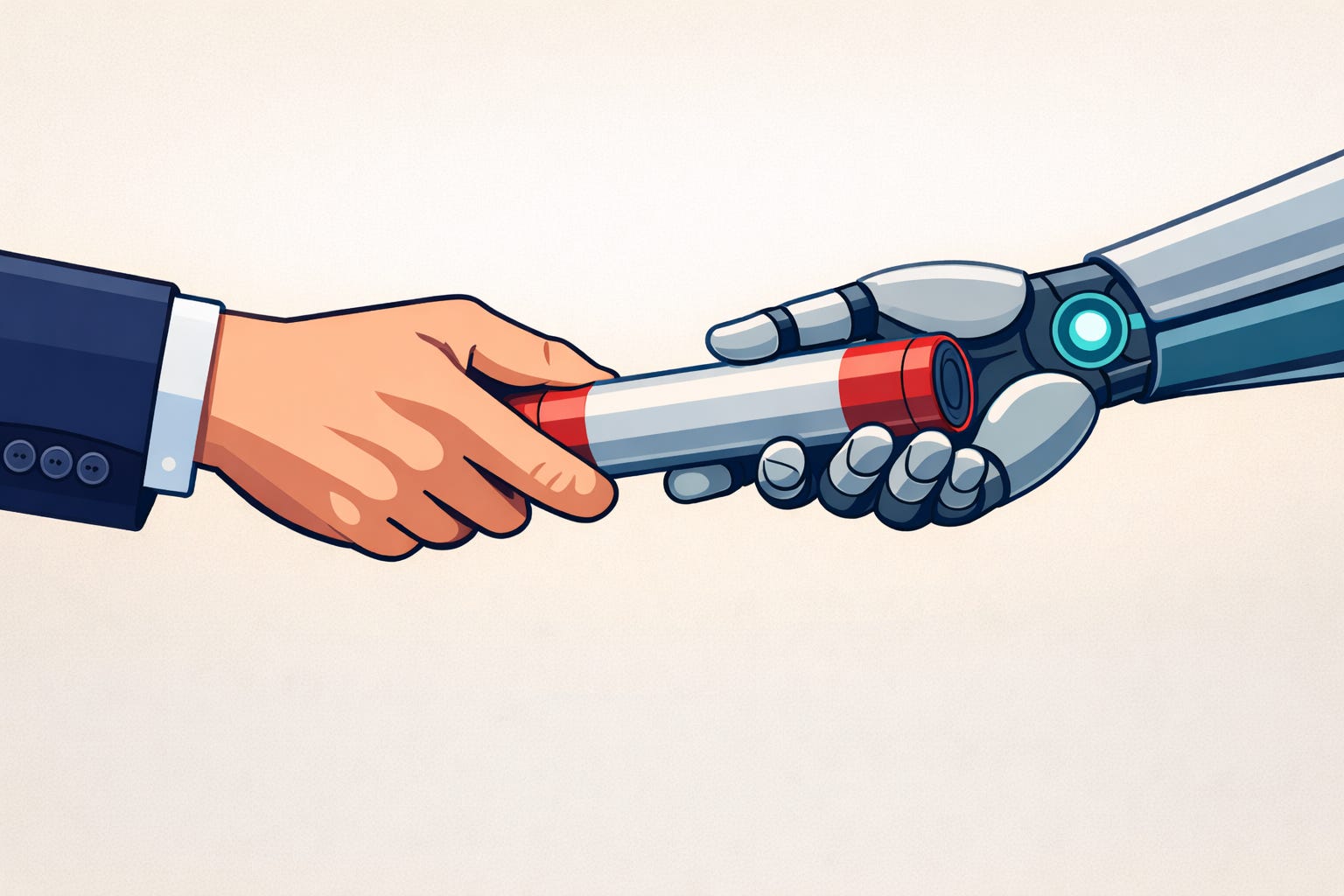
A few months ago, an AI agent called Boardy reached out to me. “I was just speaking with a Toronto-based pharma exec and they mentioned they were looking to connect with AI strategy expertise for drug commercialization,” it emailed. “Would you be up for an intro?”
I said yes, and it suggested we continue on WhatsApp. We did. Then it asked to speak on the phone. I did that too. It followed through, connecting me with someone relevant, who I met with for an enjoyable conversation.
That whole interaction was autonomously facilitated by AI across email, WhatsApp, and voice.
It worked.
It was a moment where I thought: these systems are already more capable than most people realize. They’re still hard to configure. They still have jagged edges. But when they’re easier to set up and less jagged, this is going to move fast.
That’s happening. And you need to prepare.
Beyond the assistant era
Since ChatGPT’s launch, we’ve lived in the assistant era of AI. You ask, it answers. You tell it to draft, analyze, or summarize, it does. Over time, these systems got better at agentic work too, like deep research.
But in recent months, we’ve moved firmly from the assistant era to the agentic.
Claude Code kicked this off with agentic software engineering and a series of ever-better models. OpenAI responded with Codex and a rapid sequence of stronger GPTs. The shift in coding crystallized last December, during the holiday break, when people had time to push the models to their limits. They found them very capable of being delegated meaningful work and delivering results.
Then tools like Claude Cowork and OpenClaw generalized this beyond coding. And, recently, OpenAI revealed what this could look like for enterprises with Frontier. For the first time, I saw something that made the agentic future feel tractable for large organizations: digital coworkers with skills, tools, context, oversight, and some kind of control plane around them.
At that point, the question for me stopped being, “When are autonomous AI employees coming?” It became, “What can we do now to prepare?”
Preparation that pays off today and tomorrow
While the mature agentic future isn’t evenly distributed yet, its shape is clear, and the work required to prepare for it is not speculative. In fact, most of it is useful even today, in the assistant-and-chatbot era. From what I’m seeing, and doing, I’d focus on four things: skills, tools, context, and workflows.
Package skills
Future agents will need direction to excel in their role. They’ll need instructions, heuristics, standards, examples, and constraints. In AI lingo: agent skills.
Companies should start identifying the highest-value skills in their organization and packaging them into agent skills. How do we write this kind of deliverable? How do we analyze this kind of problem? How do we prepare this kind of presentation? What does excellent look like? What are common ways to fail?
You can use skills in assistant tools like ChatGPT and Claude. Today, that looks like a human interacting with a model loaded with a skill. Tomorrow, that same skill can be part of a more autonomous digital worker.
Connect tools and data
Agents will need access to the same systems your employees use. That includes systems of record, document repositories, and communication tools.
If your AI systems cannot access your Google Drive, your Slack, your CRM, your internal knowledge, or the other key systems your teams rely on, they’ll be ineffective. So close those gaps now. Configure connectors, and build proprietary integrations if needed. Ensure your assistant AIs can already interact with the systems your future agents will need.
This is future-proofing that’s also useful for your current AI stack.
Ensure up-to-date context
This one is easy to underestimate.
It’s not enough to give AI systems static reference materials. For many use cases, critical context is dynamic and partially undocumented. In my world, for example, brand guidelines for a new drug are essential. But a brand manager’s preferences are equally important, and may be expressed informally, such as in a conversation over coffee.
Whatever the domain, the principle is the same: future agents will need rich, current working context, not just archival documents.
So while configuring and building data connections for systems of record, also consider how you’ll keep agents updated in ways you might take for granted with humans.
Rethink workflows and organizational structure
This is the part many organizations will leave too late.
Autonomous agents aren’t just a software upgrade. They change how work gets done. An individual contributor can use ChatGPT to do their job better. But working with autonomous agents is more like managing a team. You create them, onboard them, assign them tasks, and give feedback on their work.
Not everyone will want to shift from IC to manager. Not everyone will be good at it.
Agents can also collapse workflows built around sequential human handoffs into a single step because of their broader skillsets. An agent that’s good at both design and development, for example, can build a beautiful frontend interface in one step directly in code.
So organizations need to think now about supervision models, feedback loops, workflow redesign, and what agent oversight will look like for them.
You’ll have agent teams. You’ll need agent managers. You may need agent skill librarians. The future cyborg org chart won’t look like your current org chart.
It’s not too early to start
Here’s a thought experiment: what if your toughest competitor scaled its workforce next quarter with employees that worked better and faster than yours, 24/7, at lower cost?
It’s not a hypothetical. This will happen to many companies, and soon. Some industries will be slower, due to factors like AI’s still-jagged capabilities. But AI capabilities are improving faster than ever, so I wouldn’t count on that for defense.
Instead, my advice is to kick off an agent-readiness effort now. Charge it with four things: identify and package skills, improve tool and data access, build systems for context maintenance, and rethink workflows and oversight for a more agentic future.
You don’t need to predict every detail of where this is going. You just need to recognize that we can already see enough of its shape to effectively prepare.